 Image credit: Curly Check
Curl patterns describe the shape your hair naturally forms: whether it waves, spirals, coils, or anything in between. Knowing your curl pattern is a useful starting point for understanding how your hair behaves, why certain products work better than others, and what techniques tend to help.
Most people have more than one curl pattern across different sections of their head, and that's completely normal. The goal isn't to fit neatly into one category. It's to understand your hair well enough to make better decisions about how you care for it.
How The Curl Pattern System Works
The most widely used classification system organizes hair into four main types, numbered 1 through 4, with letters A, B, and C to indicate how tight or loose the pattern is within each type.
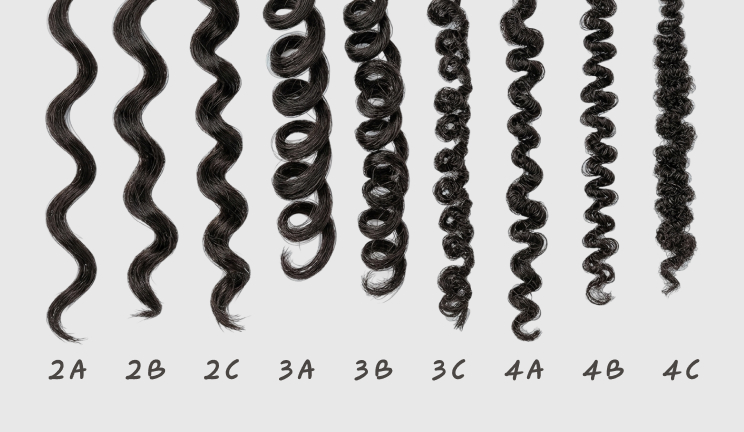
- Type 1: straight hair with no natural wave or curl
- Type 2: wavy hair with an S-shaped bend
- Type 3: curly hair with defined spirals and ringlets
- Type 4: coily hair with tight coils or a Z-shaped pattern
Within each type, A is the loosest and C is the tightest. So 2a is the loosest wave, 2c is the tightest wave before hair crosses into curly territory, and so on through 4c, which has the tightest and most densely packed coils.
This guide focuses on types 2 through 4, since that's where most curly and wavy hair falls.
Type 2: Wavy Hair
Wavy hair sits between straight and curly. It has a natural S-shape that usually starts a few inches from the roots, and it tends to lay flatter at the scalp than curly or coily hair. Wavy hair is often fine to medium in thickness, and it can range from barely-there waves to something that borders on a loose curl.
The biggest care challenge for wavy hair is usually weight: too heavy a product flattens the wave, too little leaves it frizzy. Most wavy hair does best with lightweight formulas applied to soaking wet hair.
2A: Loose, fine waves
- What it looks like: a gentle S-shape that appears mainly at the mid-lengths and ends, with little to no texture at the roots. The wave is subtle and can easily look like straight hair when dry.
- Key characteristics: usually fine in texture, low volume, tends to lose wave definition quickly. The most likely type to go straight in humidity or after brushing.
- Care considerations: lightweight products are essential. Heavy butters, oils, and creams will flatten 2a waves entirely. A light mousse or a small amount of gel applied to wet hair helps hold the wave without weighing it down.
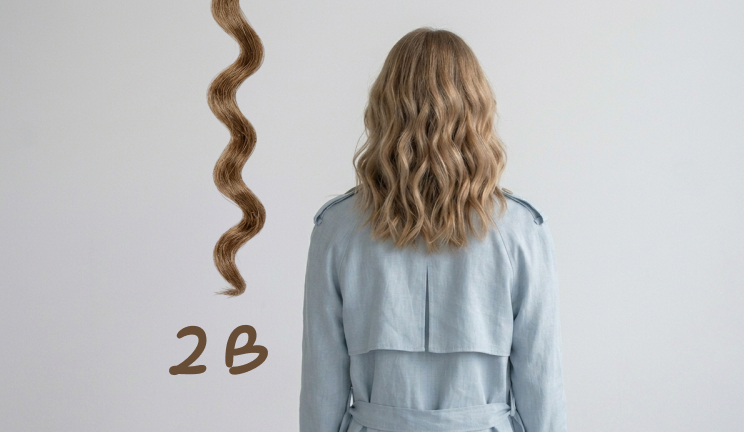
2B: Defined S-waves
- What it looks like: a more noticeable S-pattern that starts closer to the roots than 2a. There's more texture and volume, and the wave holds its shape better through the day.
- Key characteristics: medium texture, more frizz-prone than 2a, especially in humidity. Holds wave definition reasonably well with the right products.
- Care considerations: similar to 2a, lightweight products work best, but 2b can usually handle a slightly heavier formula without losing definition. Scrunching product into wet hair rather than smoothing it down helps maintain the S-shape.
2C: Thick, frizz-prone waves
- What it looks like: a strong, defined S-wave that starts at or near the roots. Some 2c strands form loose spirals rather than flat waves, and the overall texture is thicker and fuller than 2a or 2b.
- Key characteristics: the most frizz-prone of the wavy types, particularly in humidity. Hair is usually denser and may need more moisture than finer wavy types. Can sometimes behave more like 3a depending on how it's dried.
- Care considerations: 2c hair can tolerate slightly richer products than 2a and 2b, but still benefits from applying everything on very wet hair. Diffusing on low heat rather than air drying often helps with frizz control.
Type 3: Curly Hair
Type 3 hair forms defined spirals and ringlets when wet. The curls have clear shape and bounce, and they usually shrink significantly as they dry. Frizz is a common concern across all type 3 subtypes, and most type 3 hair is on the drier side because natural scalp oils have a harder time traveling down the length of a spiral than a straight or wavy strand.
3A: Large, loose spirals
- What it looks like: wide, loose spirals roughly the diameter of a marker or large chalk. The curls are bouncy and clearly defined when wet, and they tend to maintain reasonable definition when dry with the right products.
- Key characteristics: the largest curl diameter of the type 3 subtypes. Hair can be fine or medium in thickness. Frizz is common but manageable. Tends to respond well to gel and mousse.
- Care considerations: moisture is important, but 3a curls can still be weighed down by very heavy products. A leave-in conditioner followed by a lightweight gel is a common starting point. Finger coiling individual curls while wet can help with definition.
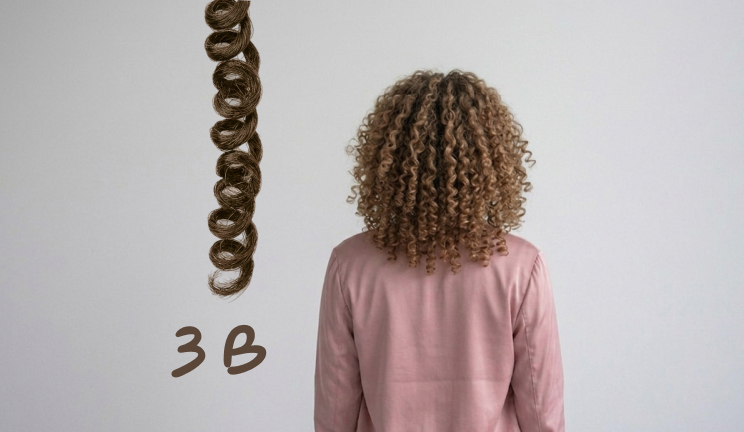
3B: Springy, medium coils
- What it looks like: tighter spirals, roughly pencil-width, that have noticeable spring and bounce. More volume than 3a, and the curls are more likely to clump into defined sections.
- Key characteristics: medium to thick texture, prone to dryness and frizz, significant shrinkage when dry. More product is usually needed than for 3a.
- Care considerations: regular deep conditioning makes a noticeable difference for 3b hair. A heavier leave-in conditioner followed by a gel or cream helps define and hold the curl. Avoid touching hair while it dries to prevent frizz.
3C: Tight corkscrews
- What it looks like: tightly coiled spirals, pencil-width or smaller, that pack together densely. High volume, significant shrinkage, and strong definition.
- Key characteristics: the tightest of the type 3 subtypes. Dryness is a common challenge because natural oils struggle to travel down very tight spirals. High shrinkage, sometimes 50% or more when dry.
- Care considerations: 3c hair benefits from richer products than looser curl types. Layering a leave-in conditioner with a styling cream or gel helps lock in moisture. Protective styles can help retain length and reduce breakage.
Type 4: Coily Hair
Type 4 hair has the tightest curl patterns and the most shrinkage of any type. The coils are so tight that they often don't form a visible spiral shape: instead, the hair bends in a Z or zigzag pattern. Type 4 hair is naturally the driest hair type because scalp oils have the greatest difficulty traveling down very tight, densely packed coils. It's also the most fragile, even though it often appears thick and voluminous.
4A: Soft, defined coils
- What it looks like: tight coils with a visible S or O shape, roughly the diameter of a crochet needle. The coils are defined and springy when moisturized, with significant shrinkage.
- Key characteristics: the most defined of the type 4 subtypes. Prone to dryness but holds product and styling well when properly moisturized. Shrinkage of 50–70% is common.
- Care considerations: regular deep conditioning and the LOC or LCO method (layering a liquid, oil, and cream in sequence to seal in moisture) helps 4a hair stay hydrated. Stretching styles like twist-outs and braid-outs can reduce shrinkage and add definition.
4B: Z-pattern coils
- What it looks like: a sharp Z or zigzag bend rather than a round coil. Less visible curl definition than 4a, with dense volume and significant shrinkage. Hair often appears to grow outward rather than downward.
- Key characteristics: high density, very prone to dryness, and more fragile than 4a due to the sharp bends in the strand. Those bends are points of weakness where breakage is more likely.
- Care considerations: moisture retention is the priority. Thick, creamy leave-ins and butters work well. Protective styling and gentle detangling (finger detangling or a wide-tooth comb on wet, conditioned hair) reduces breakage. Avoid heat styling frequently.
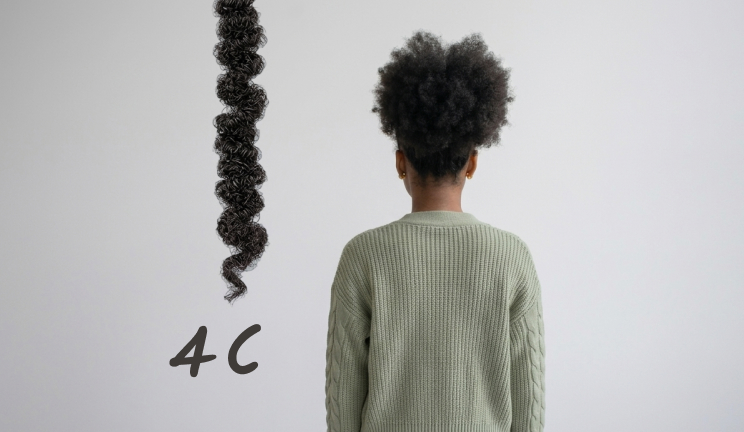
4C: Densest coils, maximum shrinkage
- What it looks like: the tightest pattern in the classification system, with very little visible coil definition without manipulation. Hair appears as a dense cloud and may shrink up to 70–80% of its actual length.
- Key characteristics: the most fragile and the driest of all hair types. Very high shrinkage can make it difficult to assess true length. Hair has high density and volume.
- Care considerations: 4c hair needs intensive moisture: regular deep conditioning, heavy leave-ins, and sealing with a butter or oil to slow moisture loss. Gentle handling is essential. Protective styles like braids, twists, and updos are commonly used to retain length and reduce manipulation.
How To Find Your Curl Pattern
The most reliable way to identify your curl pattern is to look at your hair in its natural state, before applying any products.
- Wash your hair with a gentle shampoo to remove any product buildup
- Apply only conditioner, rinse, and then leave your hair completely alone to air dry
- Once dry, look at individual strands across different sections of your head: crown, sides, and nape
- Compare what you see to the descriptions above
A few things to keep in mind:
Wet vs. dry looks different. Curls and waves are usually most defined when wet and shrink or loosen as they dry. Check both stages if you're unsure.
Most people have more than one type. It's very common to have 2c hair at the crown and 3a at the nape, or 3b at the front and 3c underneath. This is normal, not a sign that you've misidentified your type.
Products affect what you see. If you identify your type using product-loaded hair, you may be seeing the result of the product rather than your natural pattern. That's why a clean wash is the best starting point.
What Curl Pattern Means For Your Hair Care
Curl pattern is a useful piece of information, but it's a starting point rather than the whole picture. Two people with the same curl type can have very different hair care needs depending on other factors.
The most important of those factors is porosity: how easily your hair absorbs and holds onto moisture. Porosity explains why the same product can feel perfect for one person and too heavy for another, even if they have the same curl type.
In general terms, here's what curl pattern suggests about care needs:
- Type 2 (wavy): lightweight products, gentle cleansing, avoiding heavy oils and butters that flatten waves
- Type 3 (curly): regular moisture, stronger hold products to define and maintain curls, frequent deep conditioning
- Type 4 (coily): intensive moisture, protective styling, minimal heat, gentle handling to reduce breakage
But within each type, porosity, density, and strand thickness all shift what actually works. A 3a with low porosity hair needs very different products than a 3a with high porosity hair, even though their curl pattern looks the same.
If you want to check whether a specific product is a good fit for your hair, paste the ingredient list into our ingredient analyzer. It flags ingredients that are known to cause buildup or dryness, which is especially useful when you're building a routine around your curl type for the first time.
Common Questions About Curl Patterns
Can my curl pattern change?
Yes, and it's more common than most people expect. Hormonal shifts during pregnancy, postpartum recovery, puberty, and menopause can all affect curl pattern. Significant weight changes, medications, and long-term heat damage can also alter how hair grows. Some changes are temporary, others are permanent. If your pattern has shifted noticeably, give your hair a few months of consistent care before drawing conclusions about what your new baseline is.
Can I have more than one curl type?
Almost everyone does. The hair at your nape is often tighter than the hair at your crown, and the hair around your face can behave completely differently from the rest. Identifying the dominant pattern across your head is a useful shortcut, but caring for your hair means paying attention to the sections that behave differently. If you notice very different patterns in specific areas, it may be worth having two approaches: one for your looser sections, one for your tighter ones.
Is curl pattern the same as hair texture?
No. Curl pattern describes the shape of your curl (wavy, curly, coily). Hair texture refers to the thickness of each individual strand: fine, medium, or coarse. You can have tight 4c coils on fine strands, or loose 2b waves on very thick, coarse strands. Both pieces of information matter when choosing products, which is why curl pattern alone doesn't always explain why a product works or doesn't.
Do wavy and curly hair need different products?
Generally, yes. Wavy hair (type 2) is usually more susceptible to being weighed down, so it tends to need lighter formulas. Curly and coily hair (types 3 and 4) usually needs more moisture and stronger hold. That said, the overlap between 2c and 3a is significant, and someone with thick 2c hair may do better with products marketed for curly and coily hair, while someone with fine 3a hair may find wavy hair products work better. Use curl type as a guideline, not a rule.
Why doesn't my hair look like the curl type charts?
Curl type charts typically show one strand of freshly styled hair in ideal conditions. Your actual hair has multiple textures, varies by section, responds differently to humidity, and is affected by everything from how you sleep to your water quality. The chart is a reference, not a mirror. If you're between two types or your hair doesn't match any single description exactly, that's normal.
Last updated: May 05, 2026